My First Online Tea Purchase
Around the early 2000s, WeChat did not exist in China. Most people used QQ, an instant messaging service, to chat with friends and meet new people online.
One day, I received a message from a stranger on QQ.
“Hello! I’m a Tieguanyin tea farmer. Do you drink tea? If you’re interested, I can send you some of my tea. You can try it first and pay later if you like it.”
This caught my attention.
At that time, I was not a regular tea drinker. But my father drank tea every day, so I knew a little about it.
I accepted the stranger’s friend request. He showed me his tea, his tea garden, and how he made tea.
Looking back, this may have been one of the early examples of online tea marketing in China.
Online shopping was still very new. Platforms like Taobao were not yet part of everyday life, and most people had little experience buying things through the internet.
But this tea farmer had a simple idea: send the tea first, and let the customer pay after trying it.
It was a new way of doing business, and I trusted him enough to give him my address.
A few days later, the tea arrived.
As I mentioned, I was not a regular tea drinker back then. So I gave the tea to my father.
He was used to drinking green tea and was not particularly interested in Tieguanyin. His opinion was simple: “It’s not bad.”
I paid for the tea when it arrived. This was called cash on delivery, a common way to pay for online orders in those early days.
It was also my first online shopping experience. That’s why I still remember it so clearly.
How Tieguanyin Became an Online Sensation
Some time later, I noticed something strange. More and more strangers were adding me as friends on QQ. Almost all of them were selling Tieguanyin.
And I was not the only one.
Many people across China were receiving similar messages from Tieguanyin tea farmers.
What happened next was almost unbelievable.
This is the story of Tieguanyin’s rise, fall, and comeback.
Let’s step away from my personal experience and look at the bigger picture. We will go back to that exciting period and explore how Tieguanyin became an online sensation, how its reputation later suffered, and how the tea industry began to change.
1. Its Success Was No Accident
Looking back from 2026, we can see that Tieguanyin’s sudden popularity was not simply a matter of luck.
Around the year 2000, many people from Anxi, Fujian Province, began opening tea shops in different parts of China.
It was a brave move, but it also made sense.
Why do I say it was brave?
At that time, many Chinese people wanted a stable job. Having a secure position was something to be proud of. Running a business was not always seen as an attractive career choice.
If you know a little about traditional Chinese culture, you may have heard of the old social ranking known as “scholars, farmers, workers, and merchants.”
Merchants were placed at the bottom of this list.
Of course, opening a small tea shop was not considered a great achievement in those days. Business was not valued in the same way it is today.
But there was another side to this story.
People in southern China have a long tradition of doing business. They are often willing to take risks, find customers, and try new ways of making money.
Even more than twenty years later, many southern regions still have a stronger business culture and more developed private economies than many inland areas.
This background helps explain why Anxi tea sellers were ready to explore new markets.
2. A Bold Experiment with Online Sales
One thing I really admire about Fujian tea merchants is their ability to spot opportunities.
While most of us were using the internet to chat, make friends, and share photos, some tea sellers had already started using it to find customers.
I once watched an interview with a Fujian tea seller on Douyin, China’s version of TikTok.
He explained that selling tea through QQ had started almost by accident. It was not part of some carefully designed marketing plan.
But his way of selling tea was certainly bold:
Send the tea first. Get paid later.
Customers could try the tea at home. If they liked the taste and quality, they could transfer the money to the seller.
At a time when online shopping was still new, this simple idea worked surprisingly well.
It removed one of the biggest problems of buying tea online: people could not taste the tea before paying for it.
This business model also helped tea farmers reach customers far beyond their local area.
In the past, a tea shop could only serve people who lived nearby or visited the store. Now, a seller in Anxi could find customers thousands of miles away.
With QQ helping people connect, Tieguanyin spread across China at an incredible speed.
It went from being a famous local tea to one of the first major online tea sensations in China.
For a local agricultural product, this was an early internet success story.
But the good times did not last forever.
3. When the Online Sales Boom Went Out of Control
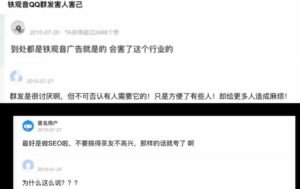
到处都是铁观音广告 会害了这个行业的
There are Tieguanyin ads everywhere. They will hurt this business.
群发是很讨厌啊,但不可否认有人需要它的!只是方便了有些人!却给更多人造成麻烦!
Group messages are annoying. But some people need them. They help a few people, but bring trouble to many more.
最好是做SEO啦,不要搞得茶友不高兴,那样的话就垮了啊
It is better to use SEO. Do not make tea lovers unhappy. If you do, you will fail.
为什么这么说???
Why do you say that?
Once people saw how much money could be made from selling tea online, more and more sellers rushed into the business.
Some were genuine tea farmers and honest business owners. Others were simply looking for quick profits.
The result was a serious problem.
The industry began to face growing pressure, and problems appeared at different stages of tea production and sales.
3.1 Tea Gardens: More Production, More Concerns
As demand increased and prices went up, many tea farmers tried to produce as much tea as possible.
More hillsides were turned into tea gardens. In some places, tea plants were grown too close together, putting pressure on the local environment.
To increase production and speed up the growing process, the use of chemical fertilizers, pesticides, and other farm products became an important concern.
Not every tea garden followed the same practices, of course. But when production became the main goal, some growers paid less attention to long-term soil health and careful farming.
This created concerns about the quality of tea leaves and possible pesticide residues.
The pressure to produce more tea in less time also made it harder for some growers to maintain traditional farming practices.
These problems would later become part of the wider discussion about Tieguanyin’s quality and safety.
3.2 Changes in Tea Making: When Market Demand Changed the Taste
The problems were not limited to tea gardens.
Tea-making methods also began to change.
Many customers wanted tea with a strong aroma, a fresh and sweet taste, and sometimes a noticeable sour note.
To meet this demand, some tea makers moved away from the traditional production style often known as Zheng Wei (traditional-style Tieguanyin).
Newer styles, often called Xiao Qing and Tuo Suan, became popular.
These methods produce different flavor profiles. They are not automatically signs of poor-quality tea. Each style has its own characteristics, and some tea drinkers enjoy these different tastes.
The real problem was that, in a highly competitive market, some producers focused too much on strong aromas and quick production.
In some cases, the result was tea with a very strong smell but a less balanced taste. Some products also lacked the depth and lasting flavor that traditional Tieguanyin drinkers looked for.
At the same time, another problem appeared: exaggerated marketing.
Some sellers began using complicated language to describe ordinary tea flavors. They talked about special mountain energy, mysterious tea qualities, and almost magical health benefits.
A normal sour taste could become a special selling point. A strong smell could be presented as proof of rare quality.
These stories made ordinary tea sound mysterious and special.
But they also distracted customers from more important questions:
How was the tea actually made? Where did it come from? Was it safe to drink? Could the seller provide reliable information about its quality?
Instead of building trust through good products, some sellers used big promises to cover up poor quality.
You can also read my other article about this subject: The Golden Age of Chinese Tea.
3.3 Market Problems: Cheap Tea and False Labels
As online tea sales grew, more tea from outside Anxi entered the market.
Some sellers offered low-quality tea at very low prices. Others put their own labels on tea from different regions and sold it as genuine Anxi Tieguanyin.
For ordinary customers, it was becoming harder and harder to tell the difference.
Good tea made with care often struggled to compete with cheaper products.
There were also concerns about artificially flavored tea and old tea being sold as fresh tea.
When customers could no longer trust what they were buying, they began to question the entire Tieguanyin category.
This was a major turning point.
3.4 Public Trust Collapsed
As these problems continued, concerns about Tieguanyin’s quality and safety received more attention.
Around the early 2010s, media reports, public discussions, and food safety checks brought issues such as pesticide residues and artificially flavored tea into the spotlight.
These reports did not mean that all Tieguanyin was unsafe. However, they made many consumers more cautious about buying it.
At the same time, China’s food safety rules and testing systems continued to develop. Requirements for agricultural products and food production became more detailed.
The old business model, which depended on fast production, exaggerated claims, and weak quality control, became harder to maintain.
Consumers were also becoming tired of the same old marketing tricks.
Other types of Chinese tea, including Pu’er tea, Wuyi rock tea, and white tea, were attracting more attention.
Tieguanyin began to lose some of its former popularity.
In just a few years, a tea that had once been extremely popular became a product that many customers viewed with suspicion.
Its online success story had come to an end.
4. A New Beginning: Better Standards, Less Hype
Did the Tieguanyin industry collapse after the online boom ended?
No.
In fact, the difficult years pushed the Anxi tea industry to rethink its business model and make changes.
Today, the industry is moving away from exaggerated online marketing and mysterious tea stories.
The focus is increasingly on better farming methods, more consistent production, and clearer quality standards.
This does not mean that every problem has disappeared. Rather, the industry is moving towards a more modern way of growing, making, and selling tea.
In other words, Tieguanyin needs to win customers back through the quality of the tea itself.
4.1 Better Management from the Source
Local authorities in Anxi have been working to improve tea garden management and production standards.
These efforts include better guidance on pesticide and fertilizer use, the promotion of more environmentally friendly tea gardens, and stronger controls over the use of banned chemicals.
Quality tracking systems have also become an important part of the industry’s development.
The goal is to make it easier to check where tea comes from, how it was grown, how it was processed, and whether it meets the required quality and safety standards.
There are also efforts to fight false product labels and the sale of tea from other regions as genuine Anxi Tieguanyin.
These changes are important because a good tea brand cannot be built on marketing alone.
Customers need to know what they are buying.
4.2 Leading Brands Help Move the Industry Forward
Large tea companies have also played a role in the industry’s development.
Two examples are Bama Tea and Fengshan Tieguanyin.
Bama Tea is one of the well-known tea brands from Anxi. It is an example of how a traditional tea business can move towards more modern production and quality management.
Rather than depending only on stories about tea and its mysterious qualities, the company has placed greater attention on production standards and product consistency.
Its business covers several stages, including tea growing, processing, product testing, storage, and transportation.
Like other large tea companies, it has more resources to invest in production equipment, quality management, and product development.
For everyday tea drinkers, consistency matters.
A tea does not have to be rare or expensive to be enjoyable. It should be clean, pleasant to drink, and reasonably consistent from one purchase to the next.
Fengshan Tieguanyin is another long-established name in the industry.
With a history connected to the state-owned tea business, the company has developed a more organized production and sales system.
Its business model includes cooperation between the company, tea-growing bases, and local farmers.
It also uses modern tea-processing equipment and works within modern food production and safety requirements.
Its retail network has expanded into many parts of China.
Both companies are examples of how traditional tea businesses can adapt to a more modern market.
Of course, a famous brand name alone does not guarantee that every product is perfect. Consumers should still pay attention to product information, quality reports, and the actual taste of the tea.
4.3 Back to What Matters: Good Tea for Everyday Drinking
After all these ups and downs, Tieguanyin is slowly moving away from the image created by the online sales boom.
It is no longer necessary to describe it as a miracle tea or make exaggerated promises about its health benefits.
What matters is much simpler:
- Traditional and well-controlled tea-making methods.
- Consistent product quality.
- Safe and responsible production.
- A clean and enjoyable taste.
Traditional-style Tieguanyin is still valued for its gentle, smooth taste and floral aroma, which is often compared to orchids.
When brewed in a gaiwan, a traditional Chinese tea bowl with a lid, good Tieguanyin can offer a clear tea liquor, a pleasant aroma, and a smooth taste that lasts through several brews.
It can be enjoyed at home, at work, or during a quiet moment in the day.
It does not need a complicated story to make it special.
It simply needs to be good tea.
That is what a modern, reliable Tieguanyin should be.
Final Thoughts
The story of Tieguanyin is also a story about the development of China’s agricultural businesses.
It shows how an industry can grow very quickly, face problems, lose public trust, and then try to rebuild itself.
This is one of the reasons I wanted to write this article.
There is a Bama Tea store in the city where I live, and I often visit to try its tea.
Green tea is still my personal favorite, but that does not stop me from following the development of Tieguanyin.
After all, more than twenty years ago, Tieguanyin was the first product I ever bought online.
Without planning to, I became part of that early online sales boom. I saw how the business grew, how problems appeared, and how the industry’s reputation later suffered.
So I am glad to see Tieguanyin moving away from the old marketing tricks and towards a more modern way of producing and selling tea.
Better standards, more careful production, and clearer information are much more valuable than mysterious stories and empty promises.
Do you drink Tieguanyin? What do you think of this tea? I’d love to hear your thoughts in the comments.